TBD on Ning
Blast IT
Views: 15760
Replies to This Discussion
-
Permalink Reply by Snagg
-
Today, in Musical History, October 24th, 1966:
Newsweek magazine interviews the Monkees.
When asked how the music is created, Davy Jones responds, "This isn't a rock 'n roll band. This is an act.", earning the anger of the other band members, who were rather serious about their musical career.|
(This reminds me of one of the first times I ever cursed in my life:
I was nine years old. Several friends and I were discussing TV show and music, and one of them blurted out "Ya know, the Archies don't really play their own instruments."
Before I completely understood what I was about to say, I replied "No shit, Sherlock - Because 'the Archies' don't actually exist. They're cartoons !"
This profanity and abruptness shocked a few of my friends. I found it refreshing.
Looking back, this moment may have influenced my life-long habit of developing opinions of the intelligence of acquaintances based on their taste in, and knowledge of, music.) -
-
-
QOTSA leader Josh Homme hasn't been shy about how long-time fans haven't been entirely happy with the news singles' experiments and trying out new sounds, which suits him and the rest of the band just fine - They were pretty sick of being straitjacketed by their fans expectations of what QOTSA were "supposed" to sound like.
(They performed a gripping, baffling appearance on "Austin City Limits" earlier this year; It might be worth tracking down online. It's weird, in more ways than one.) -
-
Permalink Reply by Angharad
-
Evolution, baby. Just watched the "Austin City Limits" appearance. That's a masterclass in musicianship and subverting expectations, imo.
-
-
-
Cover Of The Day:
"Luci Baines", released 10/64, by The American Four, a pre-Love Arthur Lee outfit - And, yes, it's about LBJ's youngest daughter.
The Jigsaw Seen picked it as one of the songs for their 2002 covers album, "Songs Mama Used To Sing". -
-
-
Today, in Musical History, October 25th, 1938: American archbishop of Dubuque, IA, Francis J.L. Beckman, denounces swing music as "a degenerated musical system...turned loose to gnaw away the moral fiber of young people", warning that it leads down a "primrose path to hell".
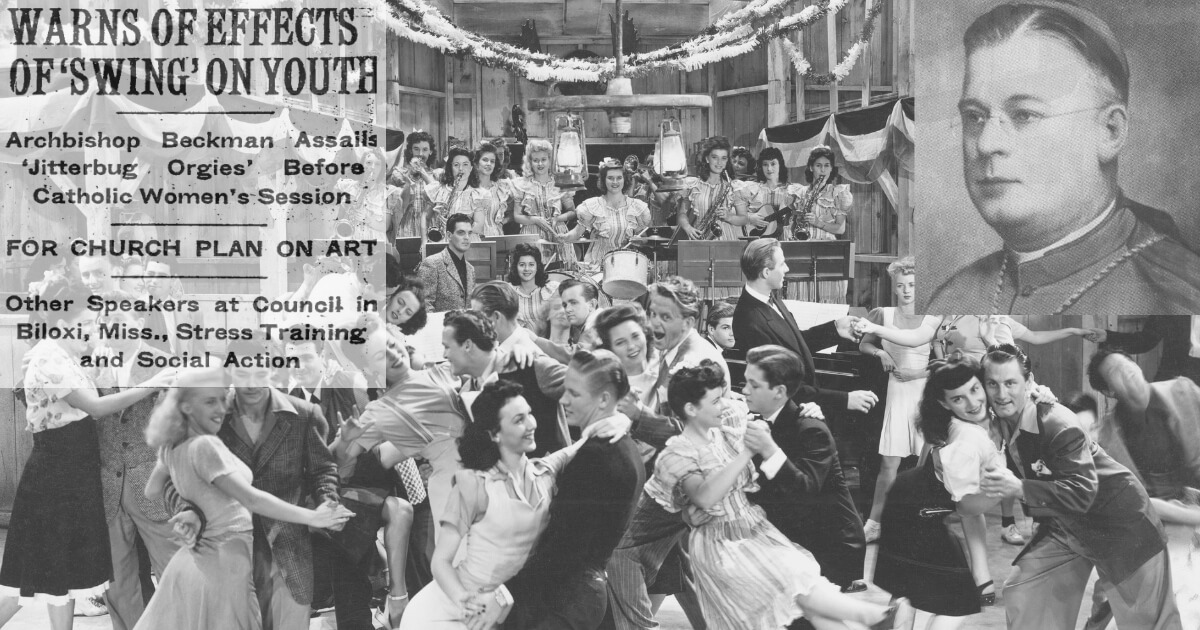
Well, how about THAT ? At least he thought it was actually music; I've certainly heard worse thrown at rock 'n roll.
Lucky for ol' Francis, he kacked it before rock 'n roll came along. -
-
-
Haha! Never heard, "kacked it." I'm assuming afterward he took a stroll down the primrose path to hell.
-
-
-
Well, I guess we can start up with the spooo-ooo-ooo-ky tunes now, right ? Right.
-
-
-
Cover Of The Day:
"Crosstown Traffic", released 10/25/1968, by the Jimi Hendrix Experience, on "Electric Ladyland"NYC's TACK>>HEAD, taking a break from being the house band at Sugarhill Records, teamed up with producer and engineer Adrian Sherwood, and blew out speakers and eardrums at a 1988 concert, at The Ritz, NYC
-
- ‹ Previous
- 1
- …
- 215
- 216
- 217
- Next ›
© 2026 Created by Aggie.
Powered by

